
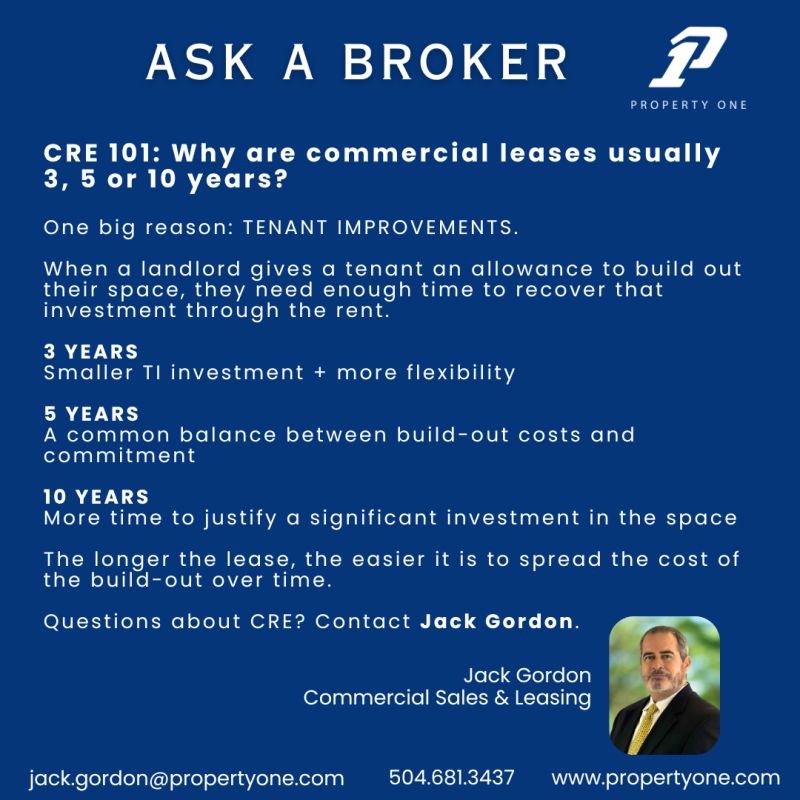
Have you ever wondered why commercial leases are so often structured for three, five, or ten years?
One important factor is tenant improvements, but the length of a commercial lease can also depend on the tenant’s needs, the landlord’s investment, market conditions, and the overall economics of the deal.
What Does Tenant Improvement Have to Do With Lease Term?
When a tenant leases commercial space, the landlord may provide a Tenant Improvement (TI) allowance to help pay for the build-out.
Depending on the space and the tenant’s needs, improvements can include walls, flooring, lighting, offices, plumbing, electrical work, and other modifications.
A substantial build-out can represent a significant upfront investment for the landlord. The length of the lease can therefore be an important part of the economics of the transaction.
Why Do Lease Terms Vary?
Three-year leases may provide greater flexibility for tenants that have relatively simple build-out needs or are uncertain about their long-term space requirements. They can also be appropriate depending on the property and market.
Five-year leases are common in commercial real estate and may provide a balance between tenant stability and the landlord’s need to recover the costs associated with preparing the space.
Ten-year leases may be considered when a tenant requires a substantial build-out or expects to remain in the location for a longer period. A longer lease can give the landlord more time to recover its investment through rental income.
These are general examples, not fixed rules. Commercial lease terms can vary significantly depending on the property, tenant, market, and negotiated terms.
It’s About More Than the Length of the Lease
Lease term is only one part of the overall deal.
Landlords and tenants may also negotiate factors such as rental rate, rent increases, tenant improvement allowances, free rent, renewal options, operating expenses, and other lease provisions.
For tenants, the goal is to find a lease structure that supports the business’s current needs while providing an appropriate level of flexibility for the future.
For landlords, the lease term is one consideration when evaluating the investment required to prepare and maintain the space for a tenant.
The Bottom Line
The length of a commercial lease isn’t simply about how long a tenant wants the space.
It can also reflect the economics of the transaction, including the amount a landlord may invest in tenant improvements and the time needed to recover that investment.
Understanding how lease term, build-out costs, rental rates, and other terms work together can help both tenants and landlords better evaluate a commercial lease.
Ask a Broker
Have questions about commercial real estate? Reach out to Jack Gordon with Property One, Inc.