
If you’ve heard the term Right of First Refusal (ROFR) in commercial real estate, you may wonder what it means and how it works.
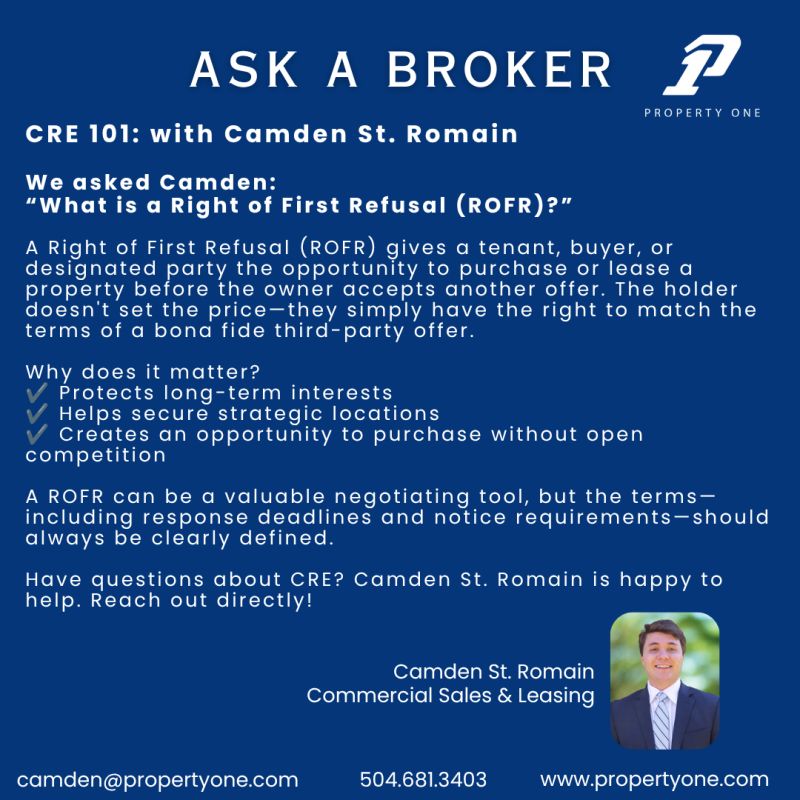
A Right of First Refusal is a contractual right that gives a designated party the opportunity to purchase a property before the owner completes a sale to a third party, subject to the specific terms of the agreement.
The holder of a ROFR generally does not establish the purchase price. Instead, the right may allow the holder to match the terms of a bona fide third-party offer if the owner decides to sell.
How Does a Right of First Refusal Work?
The exact process depends on the agreement, but a ROFR typically works something like this:
- The property owner decides to sell the property.
- The owner receives a qualifying offer from a third party.
- The owner provides the ROFR holder with notice of the offer according to the terms of the agreement.
- The ROFR holder has a specified period of time to decide whether to exercise the right.
- If the holder exercises the ROFR according to the agreement, the transaction proceeds based on the applicable terms.
- If the holder declines or does not exercise the right within the required period, the owner may be able to proceed with the third-party transaction.
The specific notice requirements, deadlines, and transaction terms are determined by the ROFR agreement.
Example of a ROFR in Commercial Real Estate
Imagine a business leases office space in a building and its lease includes a Right of First Refusal to purchase the property.
The owner later receives a bona fide offer from a third-party buyer.
If the ROFR applies to that sale and its conditions are satisfied, the owner may be required to give the tenant an opportunity to exercise its right before completing the sale with the outside buyer.
The tenant could then decide whether to exercise the ROFR under the terms specified in the agreement. If the tenant does not exercise the right, the owner may proceed with the third-party transaction, subject to the agreement.
Why Does a ROFR Matter?
A Right of First Refusal can be important to tenants, investors, and other parties with a long-term interest in a property.
For tenants, a ROFR may provide an opportunity to pursue ownership of a building where the business has established operations.
For investors or other designated parties, a ROFR may provide an opportunity to pursue a property if the owner decides to sell.
For property owners, agreeing to a ROFR can be an important part of negotiating a lease, purchase agreement, or other contractual arrangement.
What Details Matter in a ROFR?
The language of a ROFR is important. A well-defined agreement should address details such as:
- What event triggers the right
- What type of transaction is covered
- How the owner must provide notice
- What information must be provided to the ROFR holder
- How long the holder has to respond
- Whether the holder must match the third-party offer exactly
- What happens if the third-party transaction changes
- Whether the right can be assigned or transferred
- How long the ROFR remains in effect
Because the specific language can determine how a ROFR operates, parties should understand the agreement before relying on the right.
Ask a Broker
With experience in retail brokerage, investment sales, and land transactions across the Gulf South, Camden St. Romain works with clients evaluating commercial real estate opportunities and transaction terms.
Have questions about commercial real estate terms, leasing, or investment strategy? Contact Camden to learn more.