

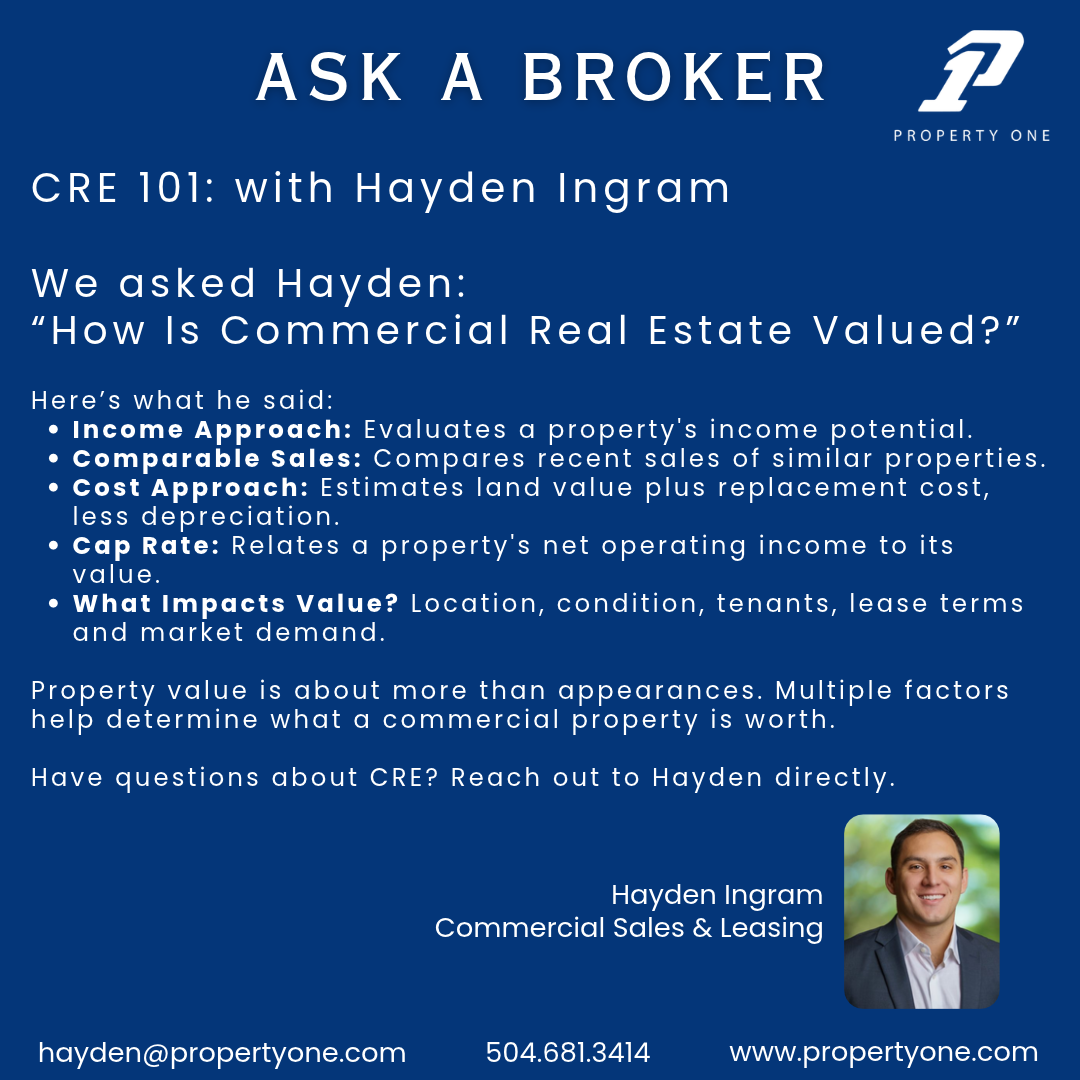
CRE 101 with Hayden Ingram: How Is Commercial Real Estate Valued?
Introduction: Commercial real estate value depends on more than size, location or appearance. Investors and appraisers consider income potential, comparable sales and replacement costs to help determine a property’s worth.
1. The Income Approach
Explain how a property’s income potential influences its value. Introduce net operating income (NOI), which is income remaining after operating expenses, before debt service and income taxes.
2. The Comparable Sales Approach
Explain how recent sales of similar properties help establish market value, considering location, size, condition, property type and timing.
3. The Cost Approach
Explain how land value and the cost to replace a building, less depreciation, help determine value. This approach can be especially useful for newer or specialized properties.
4. What Is a Capitalization Rate?
Explain how a cap rate relates a property’s annual NOI to its value. For example, a property generating $100,000 in annual NOI at a 7% cap rate has an indicated value of approximately $1.43 million.
5. Why Similar Properties Can Have Different Values
Discuss how location, tenant quality, lease terms, vacancy, expenses, property condition and investment risk can affect value, even when buildings look alike.
Conclusion: Commercial real estate valuation involves weighing multiple factors. Understanding these approaches helps buyers and property owners make more informed decisions.
Have questions about CRE? Reach out to Hayden Ingram directly.
CRE 101: How Is Commercial Real Estate Valued?



What’s My Property Worth?
Curious what your property is worth? Receive a complimentary, no-obligation Opinion of Value from one of our experienced commercial real estate professionals, backed by local market knowledge and current market data.
Fill out the form below to request your free Opinion of Value. Our team will reach out promptly to get started.
"*" indicates required fields
Get A Free Operating Expense Audit
Operating expenses quietly eat into your property’s profitability every year. Our free Operating Expense Audit, performed by our experienced property management and accounting team, delivers a thorough review of your CAM, utilities, insurance, repairs, and other costs. We benchmark them against current market rates, lease terms, and industry standards to uncover overcharges, inefficiencies, and hidden savings.
This no-obligation audit equips you with actionable insights to boost net operating income, strengthen lease negotiations, and retain more of your property’s earnings. Many landlords discover meaningful annual savings once professionals who specialize in commercial real estate evaluate their expenses.
Fill out the form below to request your free audit. Our team will reach out promptly to get started.
"*" indicates required fields