

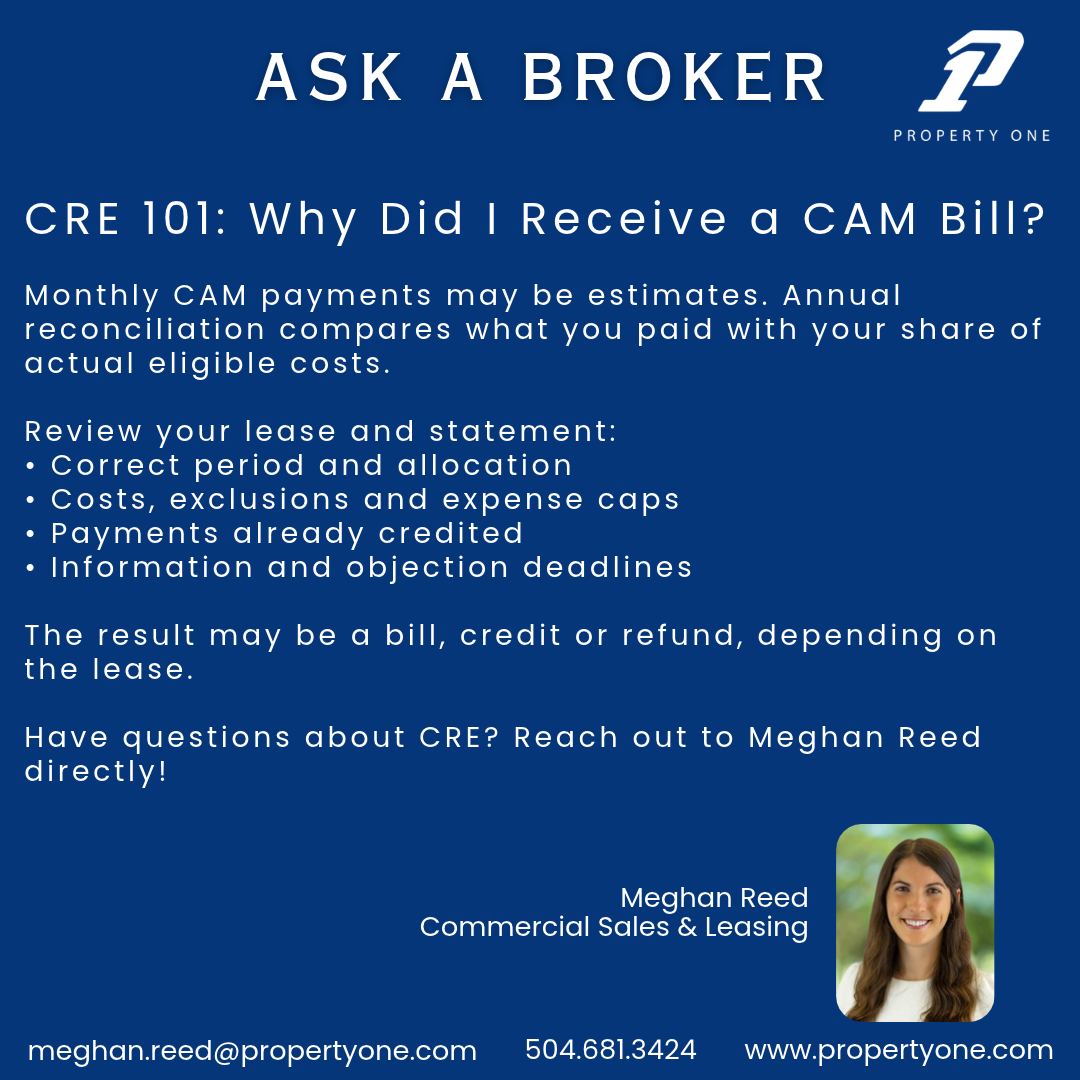
Your monthly CAM payment may not be the last word on what you owe for the year. Under most commercial leases, you pay estimated Common Area Maintenance charges each month. After the year closes, your landlord compares those payments with your share of the actual costs. That comparison is the CAM reconciliation. Depending on the numbers and your lease, you’ll get a bill, a credit or a refund.
Why are CAM payments estimated?
Your landlord sets the building’s operating budget before the year starts, when nobody knows every cost yet. A landscaping contract is predictable, but repairs are not. Instead of waiting until year-end to collect, your landlord bills your share monthly, based on the budget. That keeps the building running as bills come in. Reconciliation then settles the gap between the budget and what the building actually spent.
Leases don’t all work the same way. Some set a fixed CAM charge, and those may have no year-end adjustment at all.
How does the math work?
Say you pay $1,000 a month toward estimated CAM, or $12,000 for the year. When the landlord applies your lease’s share formula, your actual share comes to $13,200. You owe the $1,200 difference. If your actual share were $11,400 instead, you’d have overpaid by $600, and your lease decides whether you get a credit or a refund.
These numbers are only an example and don’t describe any building Property One manages. Real statements can include partial-year occupancy, different expense categories and caps on certain increases.
What should you check?
Start with your lease, not the total on the statement. Ask:
– Does the statement cover the right period?
– Did the landlord calculate your share the way the lease says?
– Does the lease allow every cost listed, and did the landlord apply the exclusions?
– Do any caps, admin fees or gross-up terms apply?
– Do the payments shown match what you actually paid?
Some leases let the landlord “gross up” certain costs that rise and fall with occupancy, to an agreed occupancy level. That doesn’t apply to every expense. Look closely at capital costs, too. Many leases exclude them or let the landlord pass through only certain ones, spread over time.
What if you have questions?
Ask your landlord to walk you through the calculation and to share the backup your lease entitles you to. A big adjustment is worth understanding, but it doesn’t mean the statement is wrong. Check your notice deadlines, payment deadlines and audit rights right away, because they may limit how and when you can challenge a charge. If you and your landlord read the lease differently, call your attorney. Don’t just stop paying.
Plan for your total occupancy cost
CAM reconciliation is one reason base rent alone doesn’t tell you what a space costs. In an NNN lease, your landlord may also bill and reconcile taxes and insurance, either separately or with CAM. If you understand the process before you sign and review your statement every year, you’ll budget more accurately. Owners who explain their costs clearly keep tenants happier.
Related reading: What Is CAM and How Is It Calculated? and What Is a NNN Lease?