
In today’s market, finding commercial space isn’t always the hardest part. Finding the right space for your business is.
One of the most common questions business owners face when planning their next facility is:
Should I lease or buy?
The answer depends on more than the current real estate market. It also depends on your business strategy, financial position, operational needs, and long-term plans.
What Should You Consider When Deciding Whether to Lease or Buy?
Business Growth and Flexibility
For businesses that are scaling, evolving, or adapting to changes in operations, leasing may provide flexibility that ownership does not. Depending on the lease terms and availability of suitable space, leasing can allow a company to preserve capital for other business priorities and adjust its real estate footprint as needs change.
This can be particularly relevant for industrial users whose space requirements may change as operations, inventory, distribution, or logistics needs evolve.
Long-Term Stability
For businesses with stable, long-term space requirements, purchasing a facility may provide greater control over the property.
Ownership can allow a business to build equity in the property and have more control over its long-term occupancy. It can also reduce exposure to future lease renewals, although ownership comes with its own costs, responsibilities, and financial considerations.
Capital and Total Occupancy Costs
The decision to lease or buy should consider more than the monthly rent or purchase price.
Businesses should evaluate the total costs associated with each option, including operating expenses, maintenance, insurance, property taxes, financing, improvements, and other costs associated with occupying or owning the property.
For tenants, lease terms and potential future increases are also important considerations.
Location and Operational Needs
The right decision also depends on how the property supports the business.
Access, visibility, parking, loading, proximity to customers or employees, building configuration, utilities, and other property characteristics can all affect how effectively a facility supports daily operations.
What About Medical Users?
Medical users may have additional considerations when evaluating whether to lease or buy.
Patient accessibility, specialized buildout requirements, parking, location stability, and the cost of relocating can all play an important role in a medical practice’s real estate decision.
For some practices, long-term control of a location may be an important consideration. For others, leasing may provide the flexibility needed as the practice grows or changes.
Aligning Real Estate With Business Strategy
The decision to lease or buy is ultimately a real estate decision that should be considered alongside broader business goals.
A business that expects significant growth may have different requirements from one that expects a stable footprint for the next decade. Likewise, a company focused on preserving capital may approach the decision differently from one looking to invest in real estate.
The key question isn’t simply, “What’s available?”
It’s “What type of real estate supports where your business is going?”
Ask a Broker
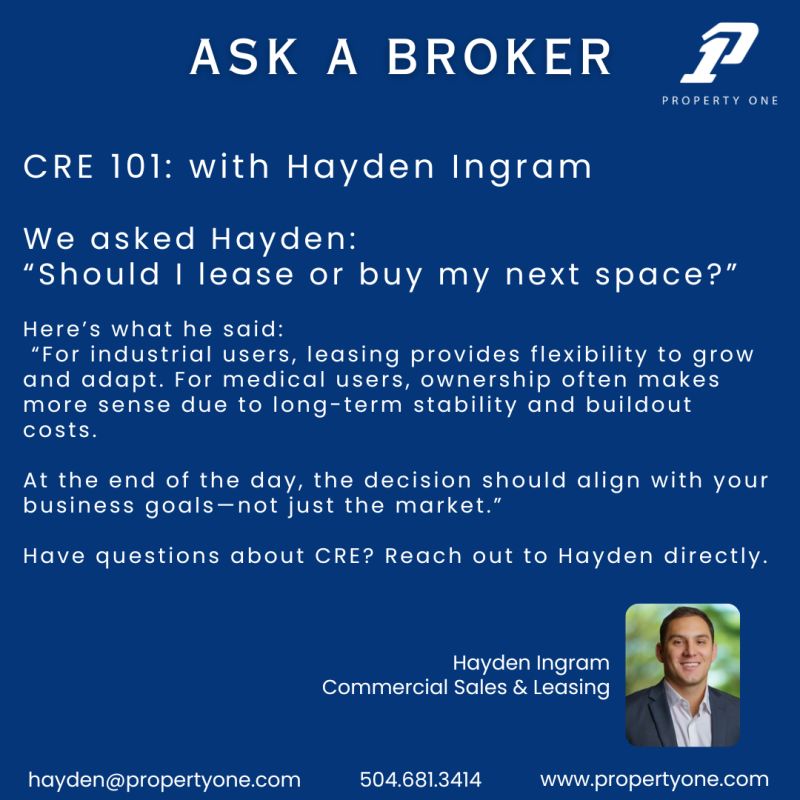
Hayden Ingram works with businesses evaluating commercial real estate opportunities and navigating leasing and acquisition decisions.
A commercial real estate broker can help clients evaluate available properties, understand market conditions, compare lease and purchase options, negotiate terms, and coordinate the transaction through closing or occupancy.
Have a question about commercial real estate? Contact Hayden to discuss your business’s real estate needs.